
By Scientific Affairs Team, Signios
The spatial transcriptomics field provides unrivaled insights into gene expression within intact tissue architecture which is crucial for both exploratory discovery and targeted hypothesis testing. Two paradigms stand out: the 10x Genomics Visium HD platform and Xenium Prime (e.g., Xenium Prime 5K imaging-based assay). This post dissects their core technologies, strengths, and optimal use cases for advanced genomic research.
Platform Overview & Chemistry
10x Visium HD (NGS-based whole transcriptome)
- Captures spatial gene expression via probe-based assay coupled with sequencing to map whole transcriptome spatial gene expression, delivering unbiased discovery capability at near single‑cell resolution.
- High-definition capture utilizes a densely packed 2 μm barcoded grid and ~6.5 × 6.5 mm capture area per slide—offering both scale and precision.
- Supports FFPE (Formalin-Fixed Paraffin-Embedded), fresh-frozen, and fixed-frozen tissues, from human and mouse enabling both retrospective and prospective studies.
- Proven to detect >18,000 genes in FFPE tissue sections, with greater transcript recovery versus earlier Visium versions.
- Supports detection of novel transcripts using custom probes.
- The new Visium HD 3’ spatial transcriptome profiling assay enables unbiased whole transcriptome profiling in fresh frozen tissue sections from any species.
Xenium Prime 5K (Targeted imaging-based spatial transcriptomics)
- Employs a 5000-plex fluorescence in situ hybridization panel on the Xenium Analyzer, delivering high-plex imaging-based spatial detection of transcripts encoded by 5,000 genes.
- Designed for single-cell resolution, assigning transcripts directly to individual cells with high morphological fidelity.
- Suitable for studies where focused gene sets enable precise, multiplexed target analyses without need for sequencing.
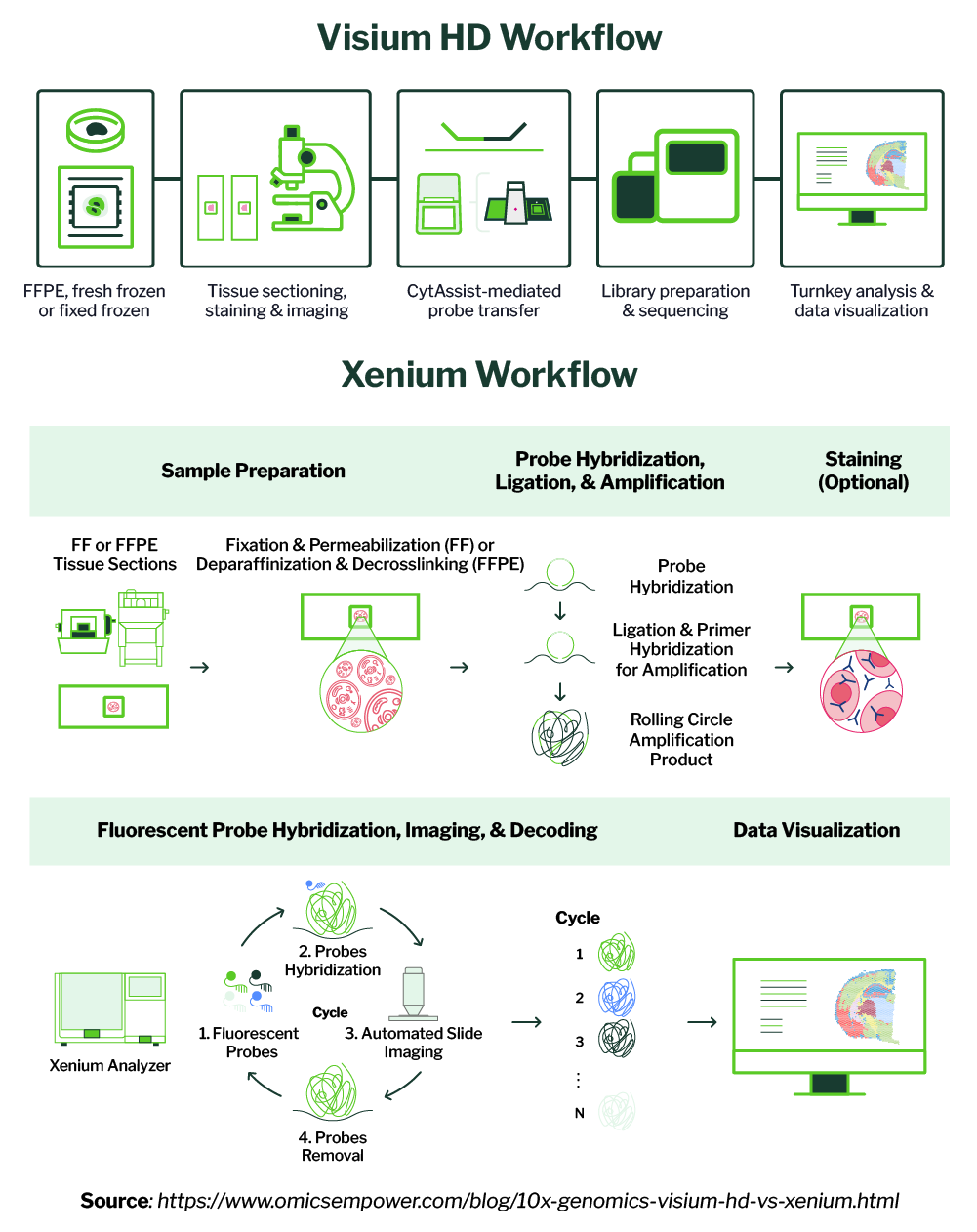
In essence, while both platforms leverage probe hybridization, Visium HD harnesses sequencing via NGS for spatial transcriptome profiling while Xenium Prime 5K uses high-plex imaging to target specific gene panels directly. Visium HD 3’ offers a probe-free, species independent approach that enables spatial transcriptome profiling in virtually any species.
Plexity, Sensitivity & Spatial Resolution
Plexity
- Visium HD: Whole-transcriptome coverage; unbiased detection of coding transcripts in human and mouse.
- Visium HD 3’: Whole-transcriptome coverage; unbiased detection of polyadenylated transcripts (both coding and non-coding) in any species.
- Xenium Prime 5K: Targeted (~5,000 genes); ideal when the gene list is hypothesis-driven or focused.
Sensitivity & Signal
- Visium HD and Visium HD 3’ demonstrates enhanced UMI capture relative to earlier Visium versions, particularly with deeper sequencing (~275M reads) and improved spatial fidelity.
- Xenium offers exceptional sensitivity, enabling reliable detection of 5,000 genes including low-abundance transcripts.
Spatial Resolution
- Visium HD: Near single-cell resolution via dense barcoded grid; cell segmentation and integration with histological imaging.
- Xenium Prime 5K: Single-cell resolution via imaging, enabling subcellular localization when paired with cell segmentation.
Sample Compatibility & Workflow
Tissue Types
- Visium HD: FFPE, fresh-frozen, and fixed-frozen – great for archival samples.
- Visium HD 3’: Fresh-frozen tissue sections – great for unbiased profiling of polyadenylated transcripts from any species.
- Xenium Prime 5K: FFPE, fresh-frozen and fixed-frozen, optimized for high-quality imaging.
Workflow & Analysis
- Visium HD includes mature pipelines such as Space Ranger and visualization tools that accelerate large-scale, discovery-oriented studies.
- Xenium Prime 5K adopts imaging and cell segmentation workflows enabling visualization through Xenium Explorer, better suited to studies with precise morphological overlays and small gene panels.
Applications & Strategic Fit
Choosing Visium HD:
- Ideal for unbiased, whole-transcriptome discovery, from novel isoform detection to comprehensive gene-regulatory mapping across tissue context.
- Suited for studies exploring unknown biology or challenging tissue types, requiring broad species applicability, or integration into large-cohort analytical pipelines.
Opting for Xenium Prime 5K:
- Fits targeted investigations, such as those focusing on well-characterized pathways, biomarkers, or multiplexed protein-RNA co-localization.
- Excels in high-resolution, cell-level spatial mapping, especially when paired with imaging-based cell assignments.
Final Thoughts
| Feature | 10x Visium HD (NGS-based) | Xenium Prime 5K (Imaging-based) |
|---|---|---|
| Coverage | Whole transcriptome (≥ 18k genes) | Targeted (~5,000 genes) |
| Sample Type | FFPE, fresh-frozen, fixed-frozen | Fresh-frozen, FFPE (imaging optimized) |
| Resolution | Near single-cell with segmentation | Direct cell assignment (single-cell resolution) |
| Workflow | Sequencing + visualization tools | In situ imaging and cell segmentation |
| Best Use Case | Discovery across transcriptome | Focused, multiplexed spatial insights |
Final Thoughts
Visium HD represents the gold standard for unbiased spatial transcriptomics, enabling high-throughput, whole-transcriptome exploration with archival sample flexibility and robust analysis pipelines. In contrast, Xenium Prime 5K offers targeted, high-resolution spatial profiling when pre-selected gene panels and imaging precision are paramount.
For research endeavors aiming at novel discovery, especially within the constraints of large-scale tissue cohorts, Visium HD stands unmatched. Conversely, investigations requiring cell-level resolution of predefined transcripts, or integrating morphology-driven insights, may find Xenium Prime 5K invaluable.
Both platforms can serve as complementary tools in a spatial omics toolkit leveraging Visium HD’s discovery power alongside Prime’s precision targeting to unravel complex tissue biology at unprecedented spatial depth and molecular detail.
#Spatialtranscriptomics, #Spatialbiology, #VisiumHD, #Xeniumprime5k, #Wholetranscriptome, #Singlecellspatial, #Highresolutionimaging, #FFPEtissue, #Tumormicroenvironment, #Multiomicsmapping