
Research grant programs
Grant Winners
We fund researchers pushing the frontier of multiomics. Explore our open programs and the awardees advancing spatial biology, proteomics, and beyond.
Research Grant Programs & Awardees
The Signios Bio × Illumina Spatial Transcriptomics Grant Program
Supporting researchers pursuing next-generation spatial biology through access to Illumina Spatial Technology — an advanced NGS-based workflow with single-cell resolution and whole-transcriptome coverage.
What's awarded
- Full access to Illumina Spatial Technology
- End-to-end library prep & sequencing
- Single-cell resolution, whole-transcriptome
- Bioinformatics support from our team
Xenium 5K Spatial Transcriptomics Grant Program Winners
First Place
Zehra Ordulu — Brigham and Women's Hospital, Harvard Medical School
Uses spatial transcriptomics to map gene expression across rare ovarian tumors and uncover how shared genetic drivers produce different tumor features and clinical outcomes.
Second Place
Yapeng Su — Fred Hutch Cancer Research Center
Uses spatial transcriptomics and CRISPR perturbation to study how the lung-cancer microenvironment shapes therapeutic T-cell behavior and influences cell-therapy effectiveness.
Rena McDonald — Neurona Therapeutics
Uses spatial transcriptomics to investigate how transplanted human interneurons integrate and function in the brain, advancing cell therapies for drug-resistant epilepsy.
Third Place
Franklin Chien, Emory University
Uses spatial transcriptomics to profile the microenvironment of pediatric brain tumors (ATRT) and identify subtype-specific features that may reveal new therapeutic targets.
Jennifer Richardson, Dren Bio
Uses spatial transcriptomics to examine how immunotherapy remodels the liver cancer microenvironment and drives anti-tumor immune responses.
Celebrating Innovation: Winners of the Signios Bio Proteomics Grant Program
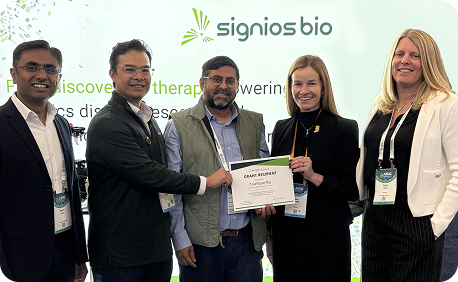
Dr. Raj’s project, “Proteogenomic Approaches to Study GBA1-Associated Parkinson’s Disease,” integrates plasma proteomics with multi-omics analyses to uncover novel biomarkers and therapeutic targets, advancing understanding of the mechanisms driving GBA1-linked Parkinson’s disease.
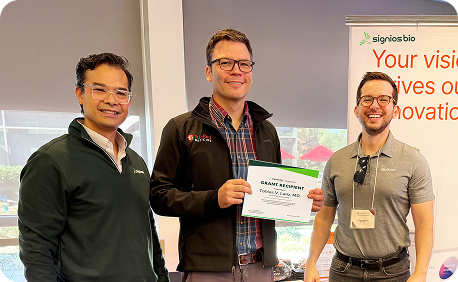
Dr. Lanz’s project, “Combining High-Throughput Antibody Screening with Next-Generation Protein Profiling to Identify Serum Biomarkers in Patients with Neuroinflammatory Diseases,” leverages Illumina’s 9.5K protein technology to discover novel serum biomarkers associated with multiple sclerosis, neuromyelitis optica, and MOG antibody disease.
The Illumina Protein Prep 9.5K™, powered by SOMAmer® technology, enables comprehensive proteomic profiling of plasma and serum by quantifying ~9,500 human protein targets on the NovaSeq™ sequencing system. Through this grant, Signios Bio and Illumina supported researchers in applying this next-generation platform to novel areas of biomedical discovery, reinforcing their shared commitment to advancing proteogenomic research through innovative, data-driven science.
2024 de novo Genome Assembly and Annotation Grant Winner
MedGenome, a leading genomics-driven research and diagnostics company, in partnership with PacBio is pleased to announce Dr. Lauren Esposito, California Academy of Sciences, as the winner of “2024 de novo genome assembly and annotation grant”.
As a leader in genome assembly and annotation, MedGenome has built AI-enabled bioinformatics tools that uses state-of-the-art technologies including PacBio long reads, Hi-C chromosome conformation capture technology and transcriptomic data, to assemble and annotate reference quality genomes for functional, comparative and evolutionary genomics studies.
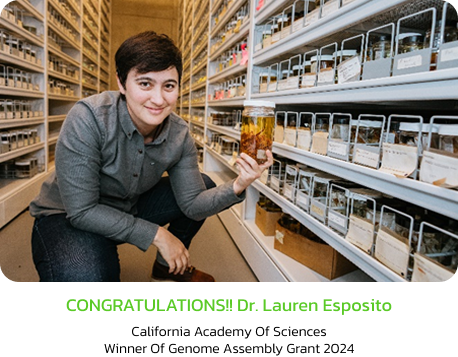
Dr. Lauren Esposito is an Assistant Curator and Schlinger Chair of Arachnology at the California Academy of Sciences. She is a leading entomologist recognized globally, specializing in scorpions, and is among the few female experts in the field. Her fascination with entomology ignited in her youth, as she avidly collected insects from her backyard, unknowingly laying the groundwork for her future career. For the past several years, Dr. Esposito has studied the evolution and geographical distribution of scorpions in the Caribbean.

Winning proposal
A Genome for the Textbook Scorpion
Scorpions have intrigued humans for thousands of years – evidenced through mythology, medicine, and art. While modern scorpions are nearly identical to their amphibious ancestors from 450 mya, scorpions today are incredibly ecologically diverse and found in nearly every major habitat on earth! What we know about “textbook” scorpion biology, from ecology, to behavior, to physiology, is based almost entirely on species endemic to California in the genus Paruroctonus – a genus with no published genome! Without an understanding of the genomic underpinnings of scorpion biology, we can’t begin to unravel the full evolutionary context for their fascinating biology. We propose to sequence and annotate the genome of Paruroctonus soda, a species found only around Soda Lake, California, that was discovered by two Californian high school students in 2022. The genome is ~1.2 Gb, the ploidy is unknown but ranges from 30-100 in related groups, and muscle tissue is available for DNA extraction.
Notable Mentions – Highly rated projects considered in the final round from over 50 abstracts

Dr. Dorota Skowronska-Krawczyk
University of California Irvine
SEQUENCING GENOME OF THE LONGEST-LIVING ANIMAL ON EARTH

Dr. Samuel Geiseler
UiT-Arctic University of Norway
INTRINSIC NEURAL ADAPTATIONS IN THE HOODED SEAL

Dr. Klaus-Peter Koepfli
George Mason University/Smithsonian
EMPOWERING CONSERVATION MANAGEMENT OF THE MANED WOLF WITH A HIGH-QUALITY ANNOTATED GENOME ASSEMBLY

Dr. Benjamin Karin University of California, Berkeley
THE RAINBOW SERPENT: THE GENOMIC BASIS OF COLORATION IN AN INDONESIAN VIPER, TRIMERESURUS INSULARIS

Dr. Kristine Todd Wylie Washington University School of Medicine
A HIGH-RESOLUTION GUINEA PIG REFERENCE GENOME FOR STUDYING HUMAN PREGNANCY
Have a project that pushes the frontier?
Applications for our current grant programs are open. See if your research qualifies.