
Oncology Sequencing Services
Precision cancer profiling, from genome to immune microenvironment
Oncology Sequencing Solutions for Solid Tumors, Hematologic Cancers, and Immune Profiling
Multiomic workflows, including TruSight Oncology 500, designed for high-resolution cancer research.
Signios Bio works with oncology researchers to generate detailed molecular data for solid tumors, blood cancers, and immune system profiling. Our sequencing services are tailored to complex study designs, varied sample types, and timelines for both translational and discovery research.
From whole-genome and whole-exome sequencing to targeted panels like TSO 500, we provide flexible, end-to-end solutions with integrated bioinformatics support to help you identify biomarkers, track tumor evolution, and study the tumor–immune microenvironment.
Comprehensive Oncology NGS Services

Solid Tumor Profiling
- Detect mutations and pathway disruptions linked to therapy resistance.
- Identify tumor subtypes with integrated gene expression and spatial profiling.
- Characterize tumor–immune interactions and microenvironmental signals.
- Analyze chromatin state and epigenetic regulation in cancer-relevant regions.

Hematologic Cancer Analysis
- Track clonal architecture in leukemias, lymphomas, and rare subtypes.
- Monitor minimal residual disease (MRD) using serial sampling.
- Reconstruct lineage hierarchies in hematopoiesis.
- Characterize immune shifts in the bone marrow.
Immune Profiling in Oncology
The immune system plays a central role in cancer progression and therapeutic response. Our oncology workflows include immune profiling tools to map immune repertoires, checkpoint expression, and functional states in both tumor tissue and circulation.
Featured Assay: TruSight Oncology 500 (TSO 500)
Pan-cancer genomic profiling from tissue or blood
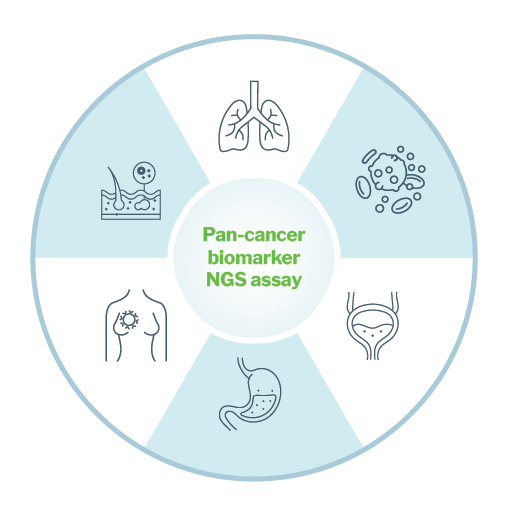
TSO 500 enables comprehensive genomic profiling of tumor samples across 523 cancer-relevant genes in a single NGS assay. It detects all major variant classes and measures key immuno-oncology biomarkers for biomarker discovery and translational research.
Key Features
- Detect SNVs, InDels, CNVs, multinucleotide variants, gene fusions, and splice variants.
- Measure microsatellite instability (MSI) and tumor mutational burden (TMB).
- Supports DNA, RNA, ctDNA, and FFPE samples.
- Requires as little as 50 ng purified DNA/RNA or 20–30 ng ctDNA.
- Typical turnaround time: 5–7 days from sample to report.
Key Features
- Solid tumor profiling: lung, melanoma, ovarian, breast, gastric, bladder, sarcoma, and more.
- Liquid biopsy analysis for non-invasive cancer monitoring.
- Immuno-oncology biomarker research.
Beyond TSO 500: Additional Oncology Assays and Workflows
Many oncology studies combine TSO 500 with other sequencing approaches to provide broader or more targeted insights.
- Whole Genome and Whole Exome Sequencing (WGS/WES): Broad mutation detection and structural variant analysis.
- RNA-Seq and Single-Cell RNA-Seq: Transcriptional profiling of bulk tissue or individual cells.
- Spatial Transcriptomics: Gene expression mapping within tumor architecture.
- Epigenetic Profiling: DNA methylation patterns and chromatin organization.
End-to-End Bioinformatics and Data Delivery
- Variant annotation using COSMIC, ClinVar, and custom filters.
- Gene expression analysis for bulk, single-cell, and spatial data.
- Immune repertoire metrics: diversity, expansion, and clonality.
- Multiomic integration (RNA, ATAC, protein) with cell type annotation.
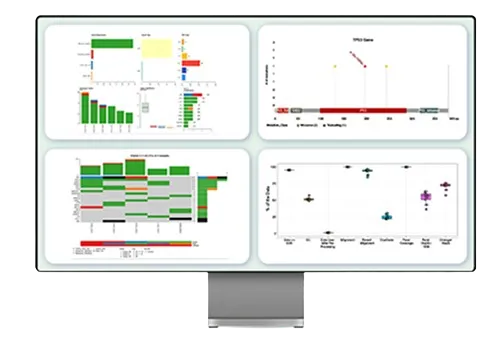
- Publication-ready visualizations and interactive reports.
Plan Your Next Oncology Study with Signios Bio
Our team can help you:
- Assess sample compatibility.
- Select optimal assays for your research goals.
- Plan sequencing and analysis workflows for your timeline.
Frequently Asked Questions
1. Which sample types are accepted for the cancer panel?
Commonly accepted inputs include fresh or frozen tumor tissue, FFPE blocks/slides, and circulating free DNA (liquid biopsy). Signios Bio pipelines are optimized for both high-quality and degraded/low-yield samples.
2. How many genes are included in your cancer panels?
We offer a range of panel sizes—from focused “hotspot” panels (20–50 genes) to broad pan-cancer panels covering 300–600+ genes, customizable based on study goals and disease context.
3. What genetic alterations can be detected by these panels?
The assays can detect single nucleotide variants (SNVs), insertions/deletions (indels), copy number variations (CNVs), gene fusions, and select structural rearrangements across targeted regions.
4. How much DNA input is required?
Standard DNA input ranges from ~50 ng to 200+ ng. Signios Bio workflows can accommodate low-input or low-quality samples—especially FFPE—while maintaining high sensitivity and depth of coverage.
5. What is the turnaround time for cancer panel results?
Typical turnaround is 2–4 weeks from sample receipt to delivery of analytical reports, with expedited options available for urgent clinical studies.
6. What data outputs do I receive from a cancer panel?
Deliverables include raw FASTQ/BAM files, annotated variant call format (VCF), comprehensive coverage metrics, variant pathogenicity reports, and interactive visualizations for easy interpretation.
7. Are these panels customizable?
Yes—modules are designed to be flexible. You can select from pre-defined panels or opt for a custom design to include genes of interest, including new biomarkers or emerging targets.
8. What bioinformatics analysis are performed?
Signios Bio provides end-to-end bioinformatics: alignment, variant calling, annotation, copy number and structural alteration analysis, plus expert-reviewed interpretation.
9. Why choose Signios Bio for cancer panels?
At Signios we combine high-quality NGS chemistry, robust low-input FFPE-compatible workflows, customizable panels, and deep analytical expertise—making us ideal partners for biomarker discovery, clinical research, and translational oncology.
Get Expert Guidance to Accelerate your Oncology Research