By Scientific Affairs Team, Signios
Proteomics has never offered more ways to measure the proteome, and that abundance of choice is exactly what makes method selection difficult. Mass spectrometry, targeted assays, and affinity-based platforms each measure proteins in fundamentally different ways, and no single approach is best for every question. The method that delivers a landmark discovery dataset can be the wrong tool for a large validation cohort, and the reverse is equally true.
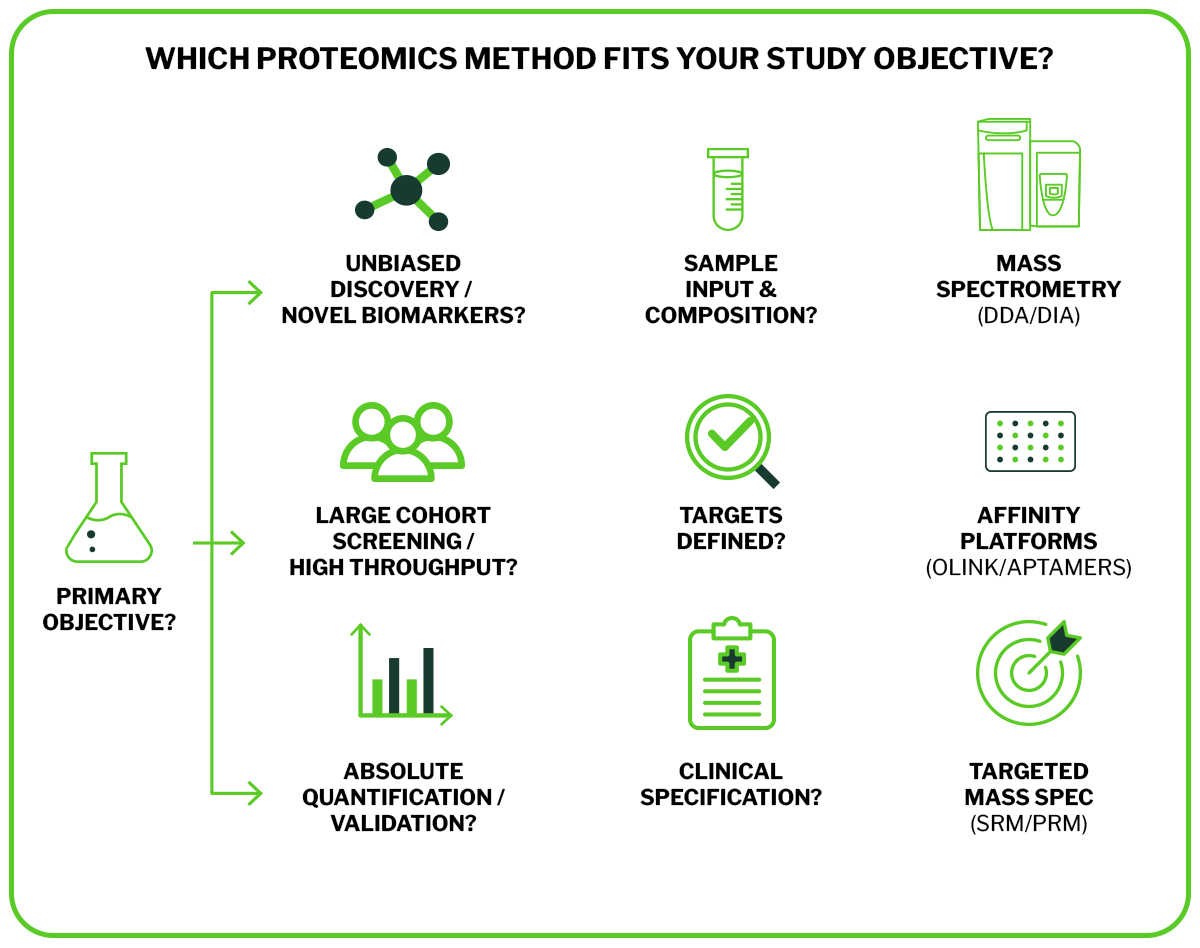
The most reliable way to choose is to start with your study goal and work backward to the technology. When the biological question drives the decision, the tradeoffs between depth, sensitivity, throughput, and cost become far easier to weigh.
Start with the Study Goal, Not the Platform
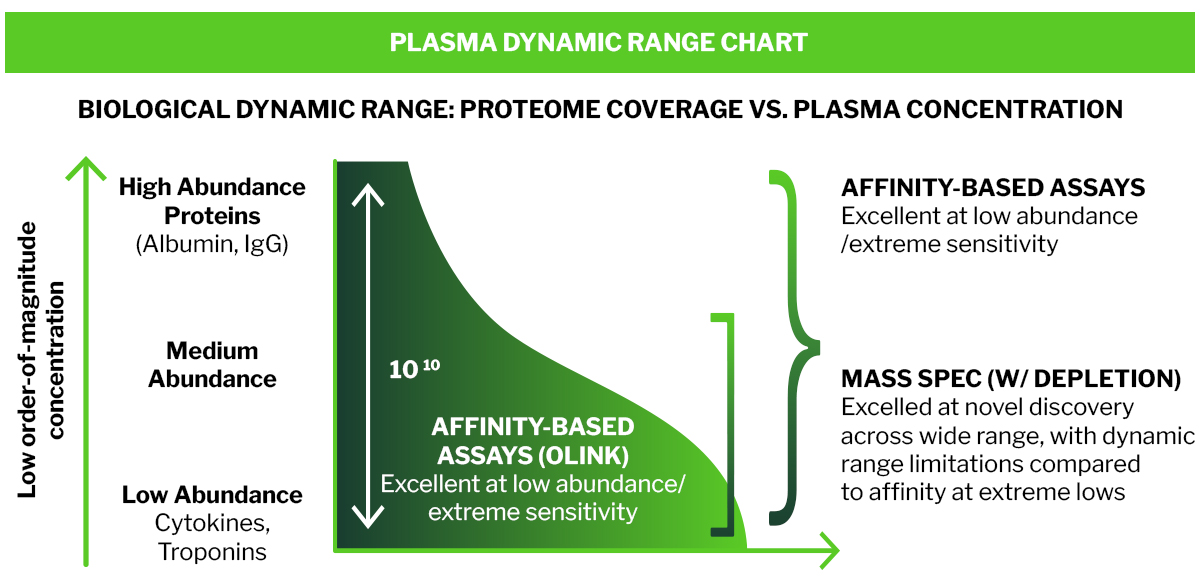
Before comparing instruments, define what success looks like. Are you searching for unknown proteins and post-translational modifications, or measuring a defined panel across thousands of samples? Do you need absolute concentrations for a regulatory submission, or relative differences between groups for hypothesis generation? Your sample type and amount matter just as much. Plasma spans roughly ten orders of magnitude in protein concentration, while a laser-dissected tissue region may offer only nanograms of input. Each of these constraints points toward a different class of method.
Mass Spectrometry: Depth, Discovery, and Proteoform Resolution
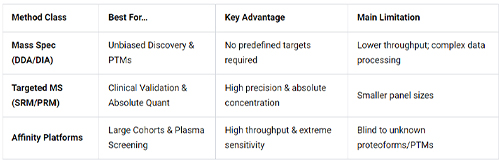
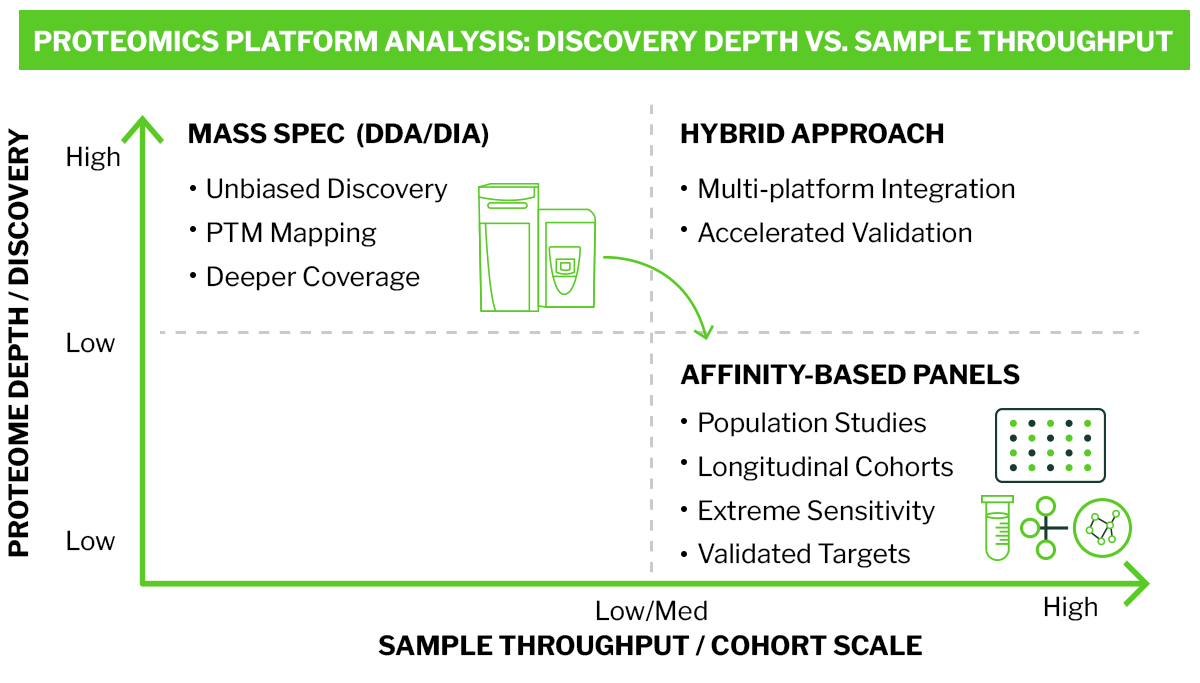
Mass spectrometry remains the workhorse of unbiased proteomics because it can identify proteins without predefined targets. Data-dependent acquisition (DDA) casts a wide net for discovery, though its stochastic sampling can leave gaps between runs.
Data-independent acquisition (DIA) has become the preferred choice for quantitative studies, producing more reproducible measurements across large sample sets. For quantification, label-free workflows keep costs low, while isobaric labeling such as TMT allows many samples to be compared within a single run.
When the goal shifts from discovery to confirmation, targeted methods like selected and parallel reaction monitoring (SRM and PRM) measure a short list of proteins with high precision and, when paired with appropriate internal standards and calibration, can deliver the absolute quantification often needed in late-stage validation or clinical assay development. Mass spectrometry remains the primary approach for resolving proteoforms and mapping post-translational modifications such as phosphorylation, whereas affinity panels generally cannot discover these without prior knowledge and reagent development. The tradeoffs are more intensive sample preparation, lower throughput, and greater run-to-run variability in discovery mode.
Affinity-Based Proteomics: Sensitivity and Scale
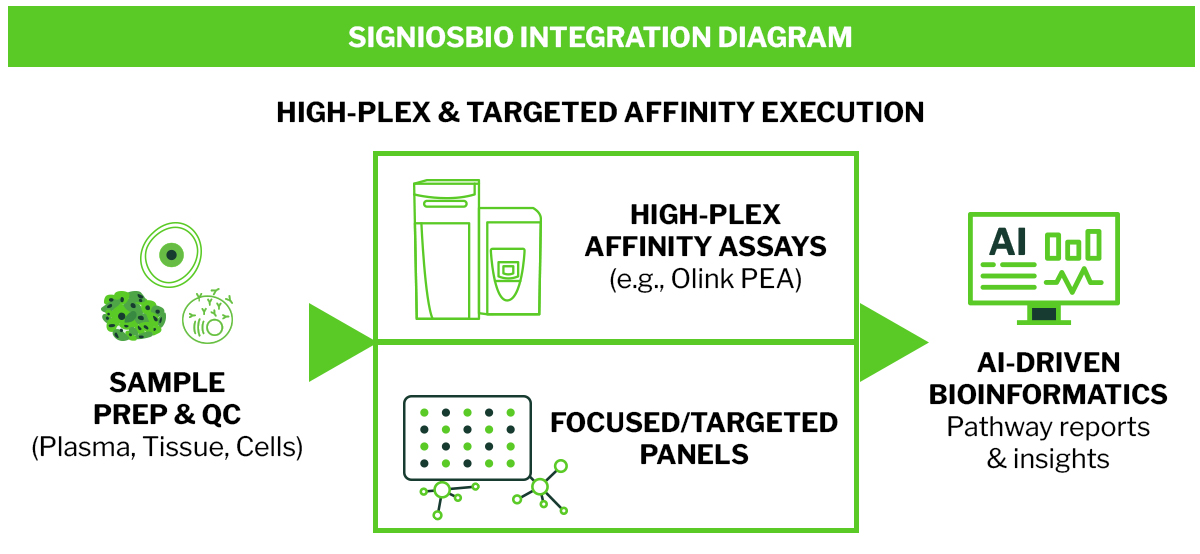
Affinity-based platforms take the opposite approach, measuring a fixed set of proteins with reagents designed for specificity. The Olink proximity extension assay pairs dual antibody probes with a sequencing readout, which gives it strong sensitivity for low-abundance proteins and the precision needed to compare thousands of samples consistently. Aptamer-based platforms such as SomaScan push coverage into the thousands of proteins per run. Because these assays need only microliters of sample and scale cleanly across large cohorts, they have become a leading option for population studies and plasma biomarker screening. Their main limitation is that they can only measure proteins included in their curated panels, so they generally cannot reveal entirely novel targets that lack affinity reagents.
Matching the Method to your Research Question
A few patterns make the choice clearer. If you are generating hypotheses, hunting for novel proteins, or characterizing modifications, discovery mass spectrometry is the natural fit. If you need to confirm a defined biomarker set with rigorous, comparable numbers, targeted mass spectrometry is built for that job.
For many large-scale and translational studies, the priority is a broad protein panel measured across a large cohort with minimal sample and high reproducibility. In those scenarios, an affinity platform like Olink is often among the most efficient options, especially when you plan to integrate the results with genomic or transcriptomic data. Throughput, dynamic range, and available sample volume usually settle the rest.