By Scientific Affairs Team, Signios
Choosing the right single-cell technology is one of the most critical decisions in modern genomic experimental design. Selecting an mismatched platform doesn’t just inflate sequencing costs—it can actively bias your data by destroying fragile cell types, failing to capture rare cell variants, or missing critical splice isoforms.
At Signios Bio, our Foster City, CA laboratory supports the industry’s four premier single-cell architectures: 10x Genomics Chromium, BD Rhapsody™, Takara SMART-Seq® (Plate-Seq), and PacBio Kinnex (Long-Read Single-Cell).
To help your team navigate these options, we have built a functional decision tree and technical breakdown to match your specific sample characteristics to the ideal platform.
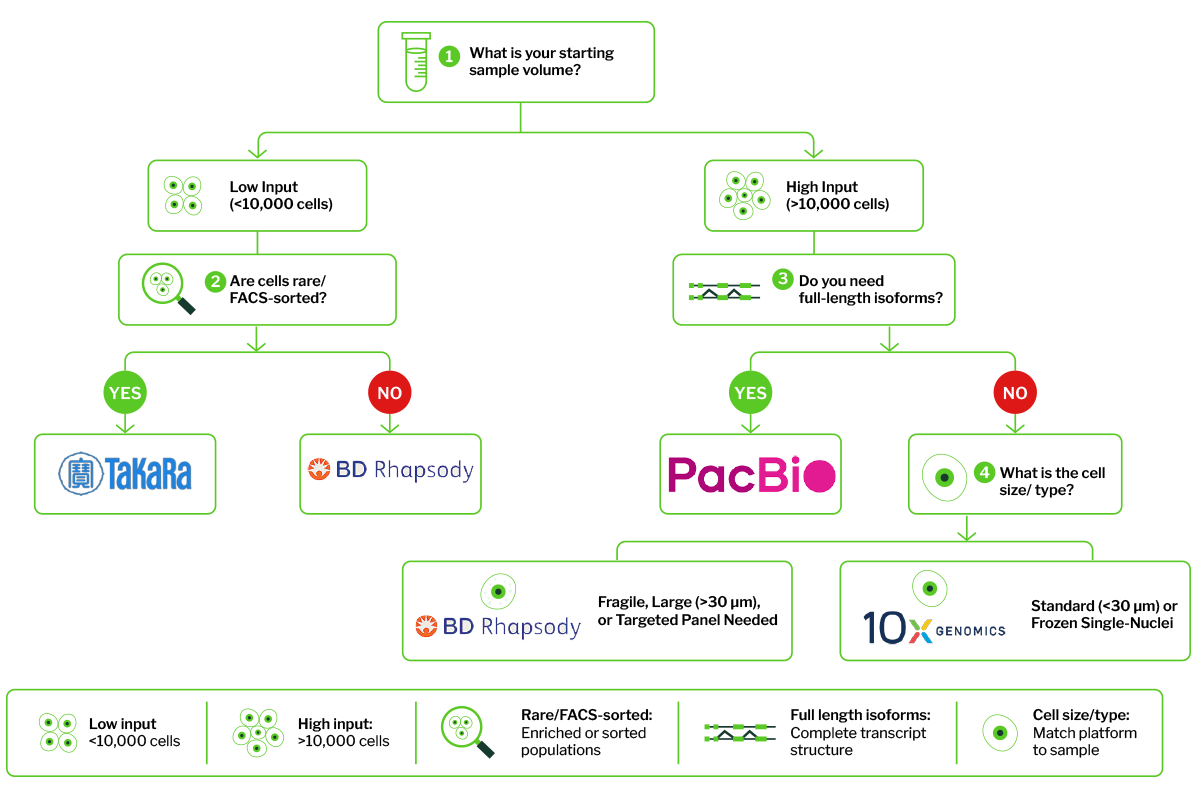
The Single-Cell Platform Decision Tree
Follow this technical logic path to narrow down your optimal sequencing configuration:
Deep Dive: The Four Framework Modalities
1. 10x Genomics Chromium (Droplet-Based)
The High-Throughput Industry Workhorse 10x Genomics relies on microfluidic channels to co-encapsulate individual cells or nuclei with barcoded gel beads inside oil droplets (GEMs).- Mechanism: Continuous, high-speed droplet partitioning.
- Best For: Massive atlasing projects, single-nuclei extractions from frozen tissues, and fixed archival clinical specimens (using Chromium Flex).
- The Technical Limit: The microfluidic channels have tight physical constraints. Large cells (over 30 – 4 µm) or highly irregular shapes risk clogging the microfluidic chips. It also requires a baseline overfill buffer, making it inefficient for precious samples with under 20,000 cells.
2. BD Rhapsody™ (Microwell-Based)
High Capture Efficiency & Large Cell Accommodation Rather than relying on active fluidic droplet generation, the BD Rhapsody uses a cartridge surfaced with over 200,000 microscopic partitioning wells. Cells are settled into the wells gently via gravity.- Mechanism: Gravity-driven microwell partitioning.
- Best For: Fragile cells sensitive to microfluidic shear stress, variable cell sizes (up to 40 µm), low-input samples where every single cell counts, and targeted transcript panels.
- The Technical Limit: While highly efficient at capturing cells without wasting material, it operates at lower throughput ceiling per run compared to high-density 10x setups.
3. Takara SMART-Seq® (Plate-Seq)
Ultra-Sensitive Full-Length Read Depth Plate-Seq isolates individual cells into separate wells of a 96-well or 384-well plate via FACS sorting, liquid handling, or microdissection, followed by full-length cDNA synthesis.- Mechanism: Well-by-well physical separation.
- Best For: Rare cell populations, fine-needle aspirates (FNA), laser capture microdissection (LCM), circulating tumor cells (CTCs), and studies requiring deep, full-length gene body coverage.
- The Technical Limit: Lower overall cellular throughput (hundreds of cells instead of tens of thousands) and a higher per-cell processing cost.
4. PacBio Single-Cell Kinnex (Long-Read)
True Isoform & Structural Variant Resolution By pairing single-cell isolation with PacBio HiFi long-read sequencing, Kinnex sequences full-length transcript molecules from poly-A tail to 5′ cap in a single pass.- Mechanism: Microfluidic/microwell library prep integrated with single-molecule real-time (SMRT) sequencing.
- Best For: Alternative splicing analysis, novel isoform discovery, gene fusion identification, and mapping structural variants within individual cells.
- The Technical Limit: Requires greater initial sequencing depth per cell compared to counting-focused short-read digital expression assays.
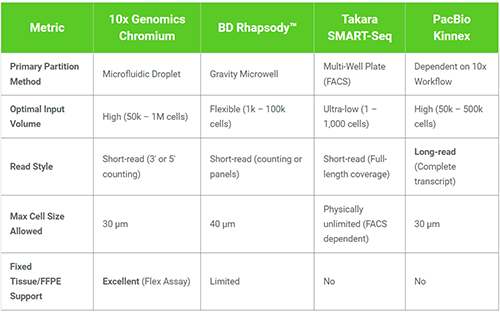
Cross-Platform Comparison Matrix