
By Scientific Affairs Team, Signios
In transcriptomics, sample quality often dictates experimental success. When working with ultra-low input samples, you rarely have the luxury of a “perfect” starting material. A researcher isolating 20 pristine, FACS-sorted stem cells faces a completely different biochemical reality than a clinical oncologist extracting cell-free RNA from a patient’s plasma or slicing a 5-year-old formalin-fixed, paraffin-embedded (FFPE) tissue block.
To extract the absolute highest data volume from precious samples, Signios Bio offers two distinct low-input pipelines powered by Takara SMART-Seq chemistry: Oligo-dT Priming and Random Hexamer Priming (with ZapR Ribosomal Depletion).
Choosing the wrong pathway can result in heavily biased data or complete library failure. This guide breaks down the science behind both strategies so you can select the correct pipeline for your specific sample type.
The Core Chemistry: How They Target RNA
The fundamental difference between these two pipelines lies in how the reverse transcriptase enzyme finds and binds to the RNA molecules in your sample.
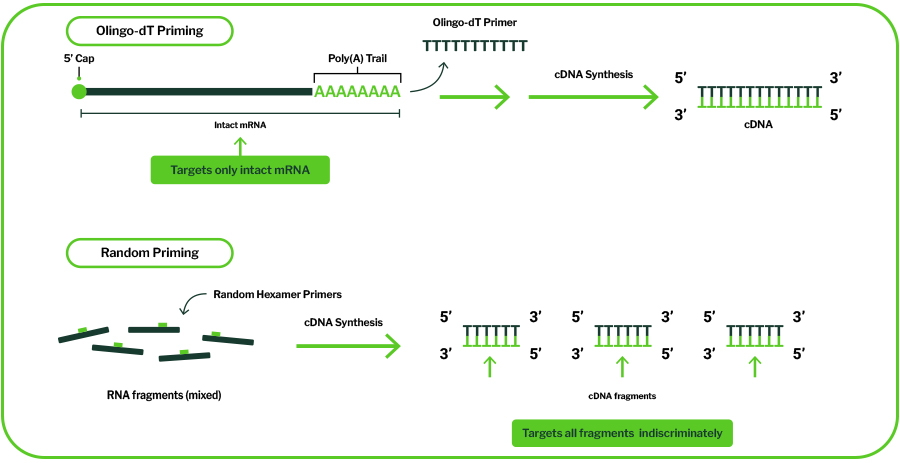
1. Takara SMART-Seq mRNA (Oligo-dT Priming)
This approach targets the polyadenylated (Poly-A) tails found exclusively on mature, fully processed messenger RNAs (mRNAs).
How it works: A specialized primer binds strictly to the 3-prime Poly-A tail of the mRNA. The reverse transcriptase then copies the transcript from the 3-prime end all the way to the 5-prime cap, where template-switching technology copies the full-length molecule without bias.
The Catch: If an RNA molecule is broken or degraded, the Poly-A tail is severed from the rest of the transcript. The chemistry will only amplify the short, broken tail piece, completely losing the informative “body” of the gene.
2. Takara SMART-Seq Total RNA (Random Hexamer Priming)
This pipeline ignores Poly-A tails entirely, making it highly flexible.
How it works: It utilizes random hexamers – short, six-nucleotide sequences representing every possible genetic combination. These oligonucleotides bind indiscriminately across the entire length of any RNA fragment present in the tube, whether it has a tail or not.
The Catch: Because it binds indiscriminately, it copies everything – including ribosomal RNA (rRNA), which typically makes up over 90 percent of a cell’s total RNA biomass. To solve this, Signios integrates ZapR technology, utilizing targeted probes and specialized enzymes that identify and enzymatically destroy unwanted ribosomal fragments while leaving your valuable target fragments completely intact.
Head-to-Head: Selecting Your Pipeline
To determine which pipeline fits your experiment, evaluate your sample against three primary criteria: RNA Integrity Number (RIN), Biomass Source, and your Experimental Endpoints.
Feature / Metric
SMART-Seq mRNA (Oligo-dT):
- Priming Mechanism: Oligo-dT (Poly-A Tail specific)
- Sample Integrity Requirement: High Only (RIN greater than or equal to 7.0 or intact cells)
- Transcript Coverage: Full-length coding mRNA
- Optimal Sample Types: FACS-sorted cells, pristine frozen tissue
- Primary Data Objective: Differential expression, isoform/splicing analysis
SMART-Seq Total RNA (ZapR):
- Priming Mechanism: Random Hexamer (Total Transcriptome)
- Sample Integrity Requirement: Highly Flexible (Degraded, FFPE, or intact)
- Transcript Coverage: Coding mRNA + Non-coding RNAs (lncRNA)
- Optimal Sample Types: FFPE slides, Liquid Biopsies, Exosomes, cfRNA
- Primary Data Objective: Biomarker discovery, fragmented clinical profiling
Scenario Analysis: Real-Bench Decisions
Scenario A: You are profiling 100 FACS-sorted immune cells.
The Reality: Your cells are alive and intact right up until they hit the lysis buffer. The RNA inside them is pristine, with long, unbroken Poly-A tails.
The Correct Path: SMART-Seq mRNA. Because your sample quality is optimal, Oligo-dT priming will yield exceptionally clean, deep coverage of full-length transcripts. By naturally excluding ribosomal RNA (since rRNA lacks Poly-A tails), 100 percent of your sequencing reads go toward active, coding genes, maximizing your sequencing budget.
Scenario B: You have a rare core-needle biopsy stored as an FFPE block.
The Reality: Fixation via formalin cross-links proteins and nucleic acids, causing massive chemical fragmentation over time. Your RIN score is likely below 3.0. The Poly-A tails are long gone or entirely detached from their coding sequences.
The Correct Path: SMART-Seq Total RNA. Attempting Oligo-dT on this sample would result in a failed library or extreme 3-prime bias. Random priming captures the shattered fragments of these precious clinical samples, while ZapR eliminates the fragmented ribosomal noise. This allows you to reconstruct a comprehensive expression profile from tissues previously deemed “unsequencable.”
Scenario C: You are exploring novel biomarkers in plasma (Liquid Biopsy).
The Reality: Cell-free RNA (cfRNA) floating in blood plasma is naturally highly fragmented due to circulating nucleases. Furthermore, many critical blood biomarkers are non-coding RNAs (like long non-coding RNAs or lncRNAs) that never develop a Poly-A tail.
The Correct Path: SMART-Seq Total RNA. You need random hexamers to bind to the short cfRNA fragments, and you explicitly need a total RNA pipeline to catch the biologically crucial non-coding transcripts that an Oligo-dT assay would completely ignore.
Final Decision Checklist
Before submitting your low-input samples to the Signios team, use this quick technical framework to align your project goals with our chemistry: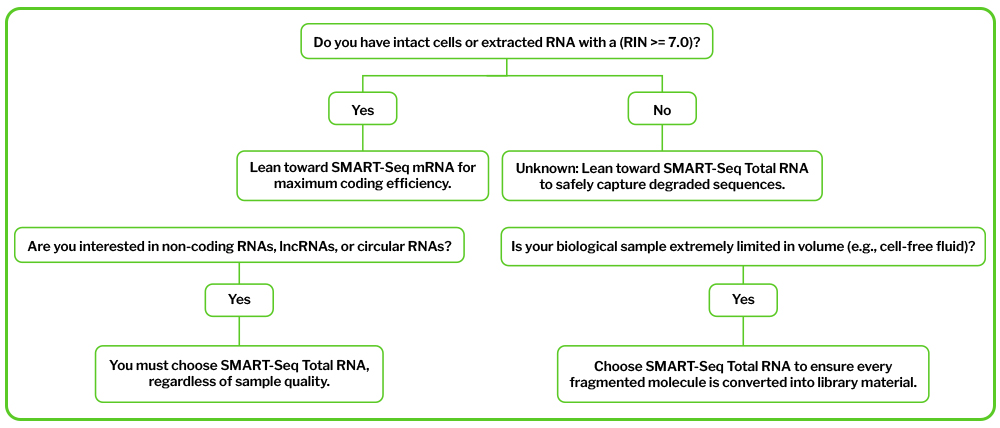
By matching your priming strategy directly to the physical state of your sample, you avoid technical bias, safeguard your precious biological material, and ensure every sequencing read delivers meaningful biological insight.