
By Scientific Affairs Team, Signios
If you work with clinical biobanks or archived human tissues, you know that Formalin-Fixed, Paraffin-Embedded (FFPE) tissue blocks are a scientific goldmine. They hold decades of patient history, treatment outcomes, and clinical endpoints. However, trying to extract high-quality nucleic acids from them can feel like a fool’s errand.
For years, molecular biologists have relied on the RNA Integrity Number (RIN) to audit their samples before running an RNA-Seq experiment. But if you pass an FFPE-derived sample through an Agilent Bioanalyzer or TapeStation and expect a helpful RIN score, you will almost always be met with a demoralizing result: a flat, chaotic baseline and a score somewhere between 1.0 and 2.5.
In the past, a RIN score that low meant throwing the sample in the waste bin. Today, it simply means you are using the wrong metric. For archived transcriptomics, the RIN score is obsolete—and the DV200 value is the only metric that matters. Here is why.
Why the RIN Score Fails in FFPE Samples
To understand why the RIN score fails, we have to look at how it is calculated. The RIN algorithm evaluates the sharp, distinctive peaks of the 28S and 18S ribosomal RNA (rRNA) fractions. In pristine tissues or fresh frozen cells, these two massive ribosomal units make up the vast majority of total RNA. If they are intact, the algorithm safely assumes the surrounding messenger RNA (mRNA) is intact too.
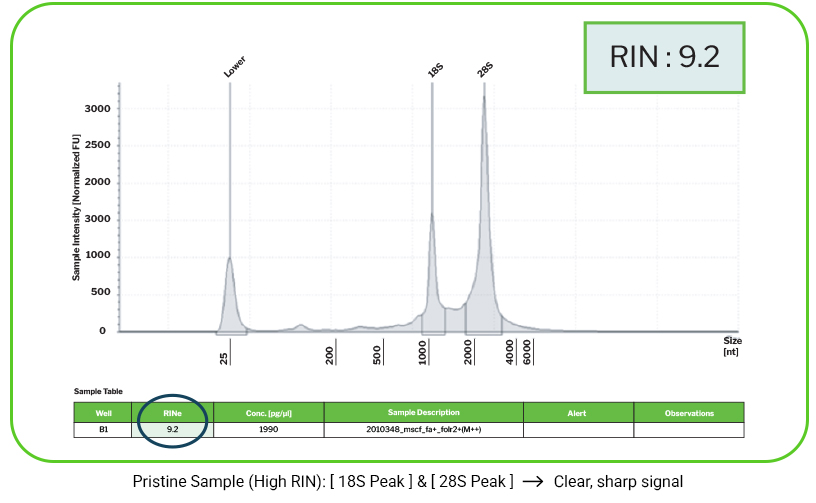
Formalin preservation destroys this structure instantly. The fixation process introduces aggressive chemical cross-linking between proteins and nucleic acids. Later, when the tissue is baked, embedded in wax, and stored at ambient temperatures for years, atmospheric oxygen and moisture slowly shear the long RNA chains.
Because the 28S and 18S ribosomal subunits are physically large molecules, they are the first to fracture into smaller segments. Consequently, your bioanalyzer trace shows no distinct ribosomal peaks—just a broad, continuous smear of short fragments. The RIN algorithm sees this smear, assumes complete sample degradation, and automatically spits out a failing score of 2.0.
However, highly fragmented RNA is not the same as useless RNA.
Enter the DV200: Quantifying the Fragment Smear
Developed to salvage these exact clinical samples, the DV200 metric completely ignores the presence or absence of ribosomal peaks. Instead, it calculates a simple percentage: the proportion of RNA fragments that are longer than 200nt.
DV200 = Mass of RNA Fragments > 200nt.
Even if every single 28S and 18S ribosomal molecule in your sample has been degraded and fragmented, thousands of your coding mRNA segments may still be 250, 400, or 600 nucleotides long.
A fragment length of more than 200 nucleotides is the exact critical threshold required for modern random-primed library prep chemistries (like Takara SMART-Seq Total RNA) to successfully bind, perform template switching, and generate a readable sequencing library.
Reading the Smear: What Your DV200 Score Actually Means
When you receive an electropherogram smear analysis from your lab or core facility, your DV200 percentage dictates your project’s technical feasibility and required sequencing depth.