
By Scientific Affairs Team, Signios
When designing a single-cell transcriptomics study, selecting the appropriate assay chemistry determines how you collect samples, manage budgets, and structure your data. The traditional choice has been the 10x Genomics Chromium Standard (Universal 3′ or 5′) workflow, which captures native poly-adenylated (poly-A) mRNA from live, intact cells. However, the introduction of the Chromium Fixed RNA Profiling (Flex) platform provides a probe-based alternative that uses chemical fixation to change the rules of single-cell logistics.
For translational researchers, clinical trial operators, and core facility directors, selecting between these platforms is not a matter of finding the “best” chemistry—it is about matching your project’s constraints to the right technological framework. This guide outlines the core mechanisms, operational trade-offs, and critical decision points to help you select the optimal pipeline for your study.
1. Core Technological Variations
The functional differences between these platforms stem from how they handle and barcode raw transcripts inside microfluidic droplets.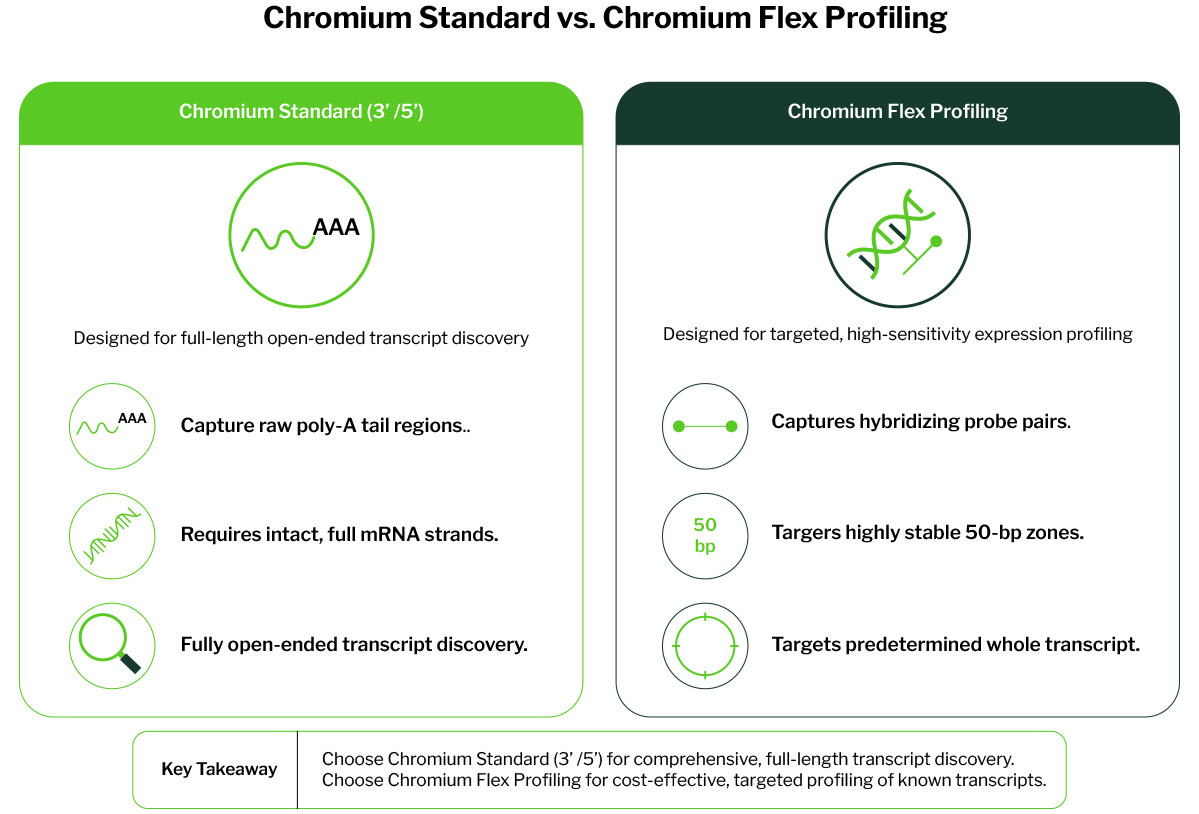
- Chromium Standard (Universal): Captures the natural 3′ or 5′ ends of transcripts using an open-ended, sequence-agnostic method. Because it sequences the actual cDNA generated directly from the cell’s native RNA, it can capture any poly-adenylated molecule, including unknown transcripts, private somatic variants, and custom vector constructs. However, it requires highly active, unbroken mRNA.
- Chromium Flex Profiling: Uses a targeted, probe-based capture method. Cells or nuclei are fixed using formaldehydes, which cross-link and lock transcriptomic states in place. Samples are then incubated with a pre-designed pool of thousands of probe pairs that hybridize to specific, highly conserved 50-base-pair regions across more than 18,000 protein-coding genes. If the left and right probe partners find their target, they are ligated together. The instrument then sequences these synthetic probe ligations rather than the native cell transcript.
2. Sample Logistics & Input Compatibility
The absolute requirement for fresh, highly viable starting material is often the single greatest point of failure in standard single-cell studies.
Input Tolerance & Storage Matrix
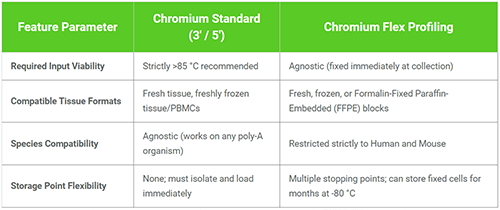
If your study involves collecting tissue from remote clinical centers, processing fragile biopsy samples over long longitudinal timelines, or utilizing archival pathology archives, the live-cell requirement of Standard GEX creates a massive operational bottleneck.
Because the Flex workflow fixes cells at the point of collection, it preserves the immediate biology and completely removes processing urgency. Once fixed, samples can be safely shipped across country or stored in a freezer to be processed simultaneously.
3. High-Density Multiplexing and Scale
Managing library preparation costs and technical batch effects are critical considerations when scaling single-cell studies to cohorts with dozens or hundreds of patients.
- Standard Singleplex Configurations: In traditional 3′ or 5′ lanes, loading distinct unpooled samples requires separate microfluidic channels. To multiplex samples on a standard chip, you must incorporate external antibody-conjugated lipid or cell-hashing oligos (like TotalSeq™-B or C) during the wet-lab prep. This introduces additional staining steps, potential antibody cross-reactivity risks, and increased costs.
- Flex Plate-Based Multiplexing: The Chromium Flex platform features built-in molecular barcodes embedded directly within the probe sets themselves. This allows researchers to hybridize and pool up to 16, or even up to 384 samples inside a single 96-well plate configuration (using high-throughput Flex Apex workflows). Because samples are pooled before loading onto the microfluidic chip, you can process millions of cells simultaneously in a single lane, reducing your overall library preparation costs.
4. The Architectural Decision Tree
To determine whether your project requires a Standard poly-A or Fixed probe-based framework, follow this strategic workflow: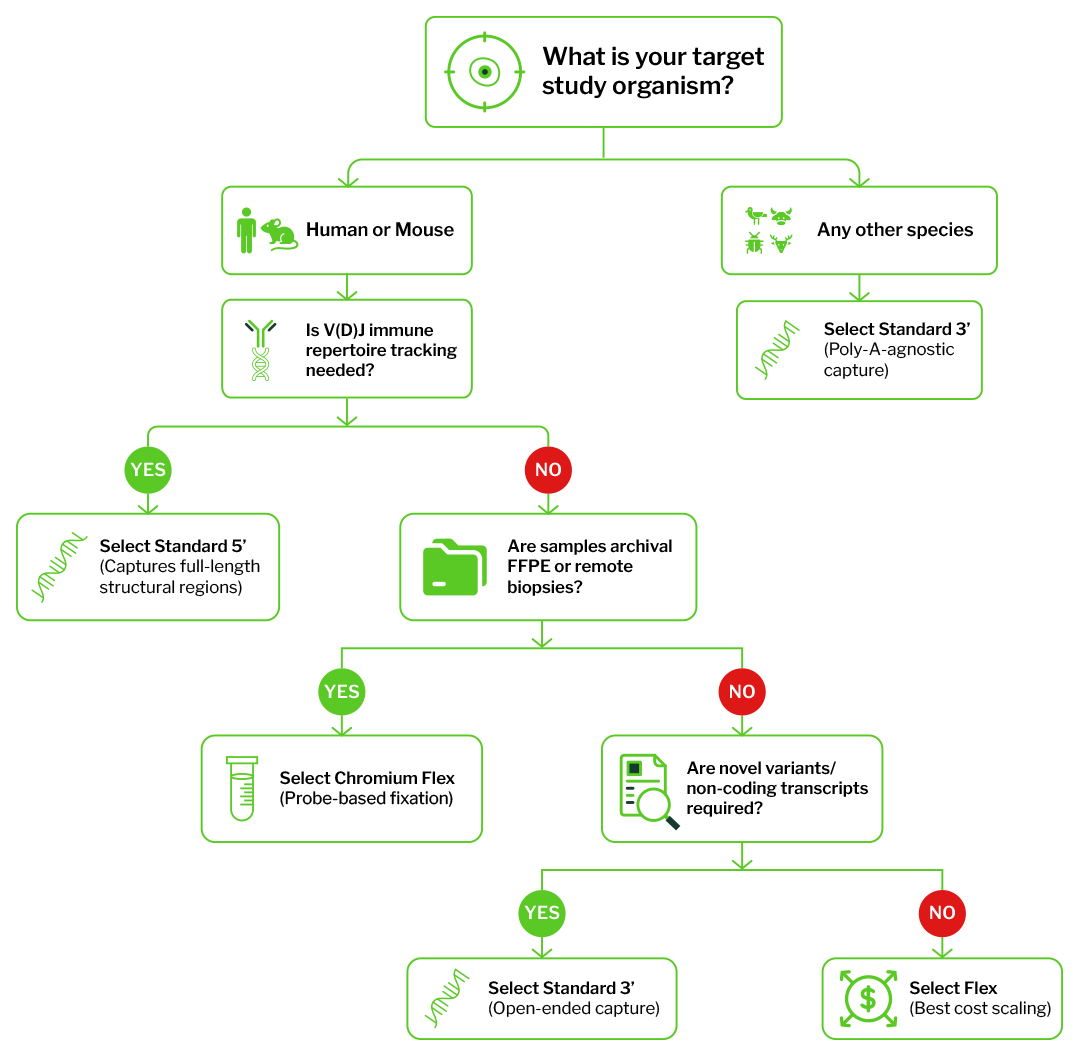
5. Technical Recommendations Summary
When to Deploy Chromium Standard (3′ / 5′)
- Non-Model Organisms: Any project profiling species outside of humans or mice requires standard poly-A discovery capture.
- Adaptive Immune Repertoire Profiling: If your primary endpoint requires identifying full-length paired heavy/light BCR or αβ and γδ TCR variable regions, you must select standard 5′ chemistry.
- Variant & CRISPR Tracking: Investigations that require tracking novel splice variants, unannotated non-coding RNA, or specific internal guide-RNA (gRNA) structures.
When to Deploy Chromium Flex Profiling
- Clinical Trials & Multi-Site Cohorts: When samples are collected across variable time zones or longitudinal clinician schedules, allowing immediate fixation and batch processing to eliminate technical run-to-run variations.
- Archival Tissue Inventories: Projects designed to unlock retrospective data from historical, formalin-fixed paraffin-embedded (FFPE) tissue pathology collections.
- Large-Scale Screens: Multi-drug profiling or high-throughput patient cohorts where plate-based sample multiplexing reduces overall library preparation and sequencing costs.
In-Lab Execution and Technical Specifications
Whether your project requires delicate live-cell handling for a standard 5′ V(D)J configuration or multi-plate fixed processing using the Chromium Flex platform, the molecular biology specialists at Signios Bio manage the entire processing workflow. Our Foster City, CA facility provides certified, end-to-end sample isolation, quality-control monitoring, and high-throughput sequencing on our Illumina NovaSeq platforms.
To review sample preparation guidelines, check probe-set coverage specifications, or design an upcoming multiplexed cohort run, contact the single-cell engineering group via the client services portal or reach out directly to your technical account representative.
#10xGenomics, #ChromiumFlex, #SingleCellSequencing, #SingleCellGenomics, #SingleCellRNAseq, #SingleCellAnalysis, #Transcriptomics, #Genomics, #FFPE, #MultiOmics, #Bioinformatics, #PrecisionMedicine, #TranslationalResearch, #LifeSciences, #GenomicProfiling