
Deep Dive: Poly(A) Selection
The Standard for Gene Expression Profiling
Our Standard RNA-Seq Service utilizes a poly(A) enrichment strategy. This protocol uses magnetic beads coated with oligo-dT sequences that bind specifically to the poly(A) tails found on the 3′ ends of mature, processed eukaryotic messenger RNAs.
Why It’s Efficient:
Because it targets only fully processed mRNA, it filters out not just rRNA, but also immature pre-mRNAs, tRNAs, and general cellular background. Every dollar spent on sequencing goes directly toward quantifying the functional, protein-coding transcriptome.
The Catch:
Poly(A) selection requires intact RNA. If your sample has a low RNA Integrity Number (RIN < 7.0), the transcripts are fragmented. When the oligo-dT beads pull down the poly(A) tail, they only pull down the small terminal fragment attached to it. This leads to a catastrophic 3′ sequence bias, meaning you lose all data from the 5′ ends of your genes.
Deep Dive: Ribosomal Depletion
The Choice for Total Transcriptome & Fragile Samples
Instead of fishing for the mRNA tails, Ribosomal Depletion uses sequence-specific probes to bind directly to the 28S, 18S, 5.8S, and 5S ribosomal subunits. These probes are then magnetically pulled down and discarded, leaving the rest of the total RNA population intact.
Why It’s Flexible:
Because this method does not rely on the physical integrity of a poly(A) tail, it is the gold standard for degraded, low-input, or archival samples—such as those extracted from Formalin-Fixed Paraffin-Embedded (FFPE) tissues, ancient DNA, or biobanked clinical blood samples. Even if an mRNA strand is broken into dozens of small pieces, those pieces will still be sequenced.
Additionally, Ribo-depletion captures the entire transcriptomic landscape. If your experimental goals include profiling long non-coding RNAs (lncRNAs), microRNAs, or circular RNAs—many of which lack poly(A) tails—Ribo-depletion is non-negotiable.
Decision Matrix: Which Workflow Fits Your Study Design?
To choose the optimal path for your project, trace your experimental parameters through these three criteria:
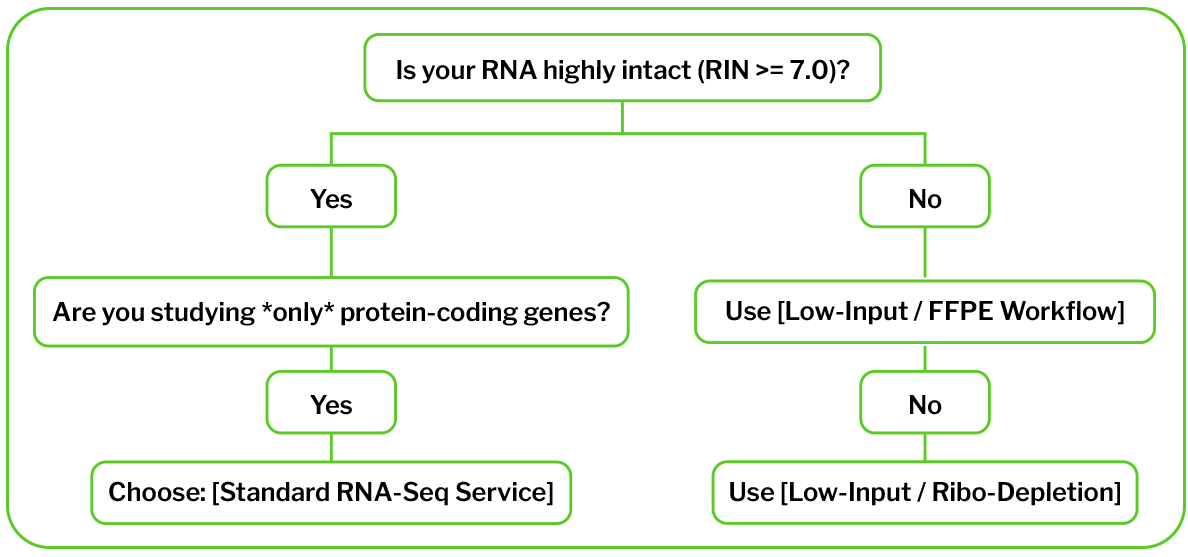
1. Choose Standard Poly(A) Selection If:
- You are performing standard Differential Gene Expression (DGE) analyses on fresh cells or frozen tissue.
- Your samples consistently pass incoming QC with a RIN 7.0.
- You need a highly cost-effective pipeline with a maximum yield of protein-coding reads per sample.
- You want to pair your library prep with strand-specific sequencing (99% directional accuracy) to confidently pinpoint antisense transcription or map tightly packed, overlapping genes.
2. Choose Ribosomal Depletion If:
- You are working with clinical tissue blocks, degraded biopsy samples, or blood samples with low-quality RNA profiles.
- Your study design focuses explicitly on non-coding RNA biogenesis, precursor mRNAs, or intron retention.
- You are looking at a species where polyadenylation pathways differ significantly from typical mammalian models (e.g., certain bacteria or specific lower eukaryotes).
Getting the Most Out of Your Selected Workflow
No matter which library preparation pathway your sample quality demands, maximizing the value of your transcriptomic data requires matching it to the correct sequencing depth.
For standard differential gene expression via Poly(A), 20–30M reads per sample is highly efficient and cost-effective. However, if you are leveraging Ribo-depletion or looking for rare alternative splicing and isoform tracking, scaling your project to 50M+ or 100M+ reads ensures deep enough coverage to capture low-abundance transcripts amidst the non-coding background.
Unsure where your samples fall? Review our detailed technical input matrices or reach out to our team of PhD-level computational biologists to match your biological starting material with the perfect high-resolution workflow.