
By Scientific Affairs Team, Signios
Every molecular biologist knows the unique anxiety of submitting samples for next-generation sequencing. You have spent weeks, perhaps months, culturing cells, dosing animal models, or meticulously microdissecting tissues. You yield what looks like a decent concentration of total RNA on the NanoDrop, pack it on dry ice, and ship it off.
Then comes the email from the sequencing provider: Sample Quality Control failed. RIN scores are too low.
It is a frustrating, costly setback, but it isn’t an arbitrary roadblock. In standard mRNA sequencing (RNA-Seq), a low RNA Integrity Number (RIN) fundamentally alters your data, introducing severe biological biases and potentially ruining your differential gene expression analysis.
Let’s break down the science behind the RIN score, exactly why poly(A) capture fails when RNA is degraded, and how you can safeguard your samples to ensure publication-ready transcriptomic insights.
What is a RIN Score, Exactly?
Historically, researchers assessed RNA quality by running a total RNA sample on an agarose gel and visually evaluating the sharpness of the 28S and 18S ribosomal RNA (rRNA) bands. If the bands were crisp and the 28S band was twice as bright as the 18S band, the RNA was considered intact.
The RNA Integrity Number (RIN), developed by Agilent Technologies, modernized this process. Utilizing automated capillary electrophoresis (such as a Bioanalyzer or TapeStation), software analyzes the entire electrophoretic trace of an RNA sample—not just the ribosomal peaks, but also the baseline signal and the presence of low-molecular-weight degradation products.
The system assigns a score from 1 to 10:
- 10: Completely intact, pristine RNA.
- 1: Highly degraded, completely fragmented RNA.
For a high-resolution workflow like our Standard RNA-Seq Service, a RIN score of 7.0 or higher is the baseline benchmark for optimal performance.
The Biology of Poly(A) Capture: Why Intact RNA is Non-Negotiable
To understand why a low RIN score breaks the standard RNA-Seq workflow, we have to look at how libraries are built.
Total RNA is overwhelmingly composed of ribosomal RNA (greater than 90% of the sample). To avoid wasting millions of sequencing reads on uninformative housekeeping rRNA, workflows must enrich for messenger RNA (mRNA). Our standard pipeline accomplishes this via poly(A) selection, utilizing magnetic beads coated with oligo-dT sequences to selectively bind the polyadenylated tails found on mature, protein-coding transcripts.
Here is what happens when your RNA is degraded: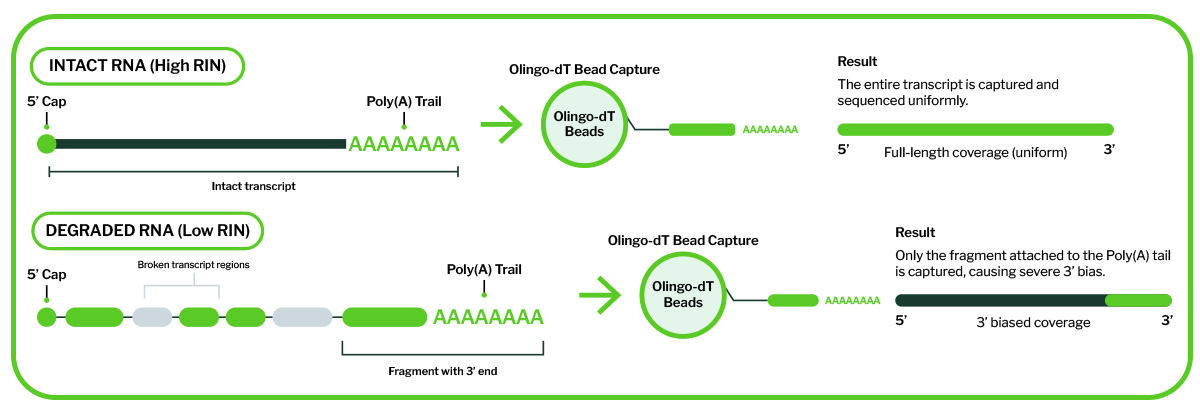
When an RNA strand fragments, the poly(A) tail on the 3’ end becomes physically detached from the rest of the gene body. When the oligo-dT beads pull down the poly(A) tails, they only pull down that terminal, broken fragment.
The Consequences for Your Data:
- Severe 3’ Sequence Bias: Your sequencing reads will cluster heavily at the 3’ ends of your genes, leaving you with little to no coverage at the 5’ ends.
- Artificial Expression Drops: Long transcripts have a higher statistical probability of containing a break than short transcripts. Consequently, degradation makes long genes look artificially down-regulated compared to short genes.
- Loss of Structural Insights: If you select our deeper sequencing tiers 50M or 100M reads) to look at alternative splicing, isoform tracking, or novel transcript discovery, degradation entirely defeats the purpose. You cannot map full-length splice variants or identify gene fusions if the 5′ and middle sections of the transcripts are missing from the library.
Actionable Steps to Safeguard Your RIN Scores in the Lab
Preventing RNA degradation requires stopping endogenous intracellular RNases the absolute millisecond a cell dies or a tissue is harvested. Implement these practices to consistently hit RIN 7.0 target:
1. Flash-Freeze or Stabilize Instantly
The clock starts the moment biological blood supply or media is removed.
- For Tissues: Snap-freeze samples in liquid nitrogen within seconds of dissection. Alternatively, submerge thin tissue pieces (<0.5 cm thick to allow rapid penetration) in stabilization reagents like RNAprotect or RNAlater.
- For Cells: Pellet your cultured cells, completely remove the supernatant media, and flash-freeze the dry pellet, or lyse them directly in your extraction buffer before freezing at -80C.
2. Radical RNase Decontamination
RNases are incredibly stable enzymes that do not require cofactors to function, meaning they can survive autoclaving and standard laboratory soaps.
- Dedicate a set of pipettes exclusively for RNA work.
- Generously spray down your entire benchtop, pipettes, and gloves with an RNase decontamination solution (like RNase AWAY) before starting.
- Always use certified RNase-free, sterile barrier filter tips.
3. Choose the Right Elution Medium
Store your purified total RNA in nuclease-free water or an Elution Buffer consisting of 10 mM Tris-HCl adjusted to pH 7.5–8.0. Avoid eluting in buffers with high EDTA concentrations, as EDTA can interfere with the downstream enzyme reactions during library preparation.
What if My Samples Have Low RIN Scores and I Can’t Re-Collect Them?
In clinical research, translation science, and bioinfomatics involving biobanked samples, high-quality RNA is a luxury you don’t always have. If you are working with fixed clinical tissues (like FFPE blocks) or highly fragile primary cells where a RIN 7.0 is impossible to achieve, standard poly(A) selection is not the right tool for the job.
But that doesn’t mean your project is dead.
For degraded inputs or low-concentration samples (50 ng total RNA), you simply need to pivot your library prep approach. Instead of capturing the fragile poly(A) tail, workflows like our Low-Input & FFPE RNA-Seq Workflow utilize Ribosomal Depletion (Ribo-Zero).
Instead of pulling the mRNA out by its tail, Ribo-depletion uses targeted probes to specifically bind and pull the background rRNA out of the sample, leaving behind all the fragments of your mRNA. This preserves uniform, transcript-wide coverage across fragmented genomes without the dreaded 3′ bias.
Ready to Sequence?
By verifying your RNA quality early and matching it to the correct library preparation technology, you save your budget and guarantee that your bioinformatic deliverables—from DESeq2 differential expression metrics to dynamic Volcano plots—reflect true biology, not processing artifacts.
If you have measured your samples and are ready to leverage high-resolution, strand-specific transcriptomics with 99% directional accuracy, explore our full technical specifications or get in touch with our team of PhD-level computational biologists to set up your project.