
Three Questions to Guide Your Choice
To filter down these options to the correct service for your specific workflow, ask yourself three practical questions about your experimental design.
1. Are you looking for a specific target, or are you hunting blindly?
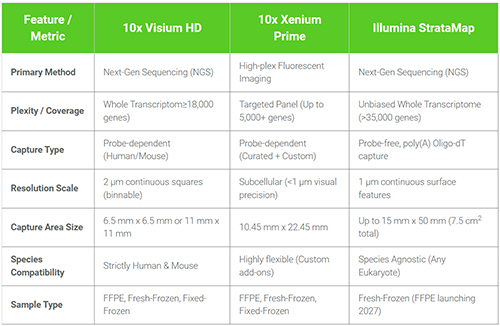
If you are running an open-ended, hypothesis-free discovery study—or hunting for uncharacterized splicing variants, rare cell states, or unexpected markers—you require a whole-transcriptome layout.
- Visium HD gives you full transcriptome depth at an incredibly fine 2 µm single-cell scale, but restricts your study to standard human or mouse pathways.
- StrataMap uses a probe-free poly(A) approach, making it completely species-agnostic. If you are working on agricultural models (like maize), non-traditional animal lines, or complex translational targets, StrataMap captures everything with poly(A) tails without assay redesign.
- Xenium Prime caps your view at a pre-designed gene window. While its panels are massive and heavily curated for tissue-specific pathways, it remains a closed-box system where you must know what you are looking for beforehand.
2. How big is your tissue (and can you afford to cut it up)?
Tissue real estate is often the ultimate deciding factor when arranging slide architecture.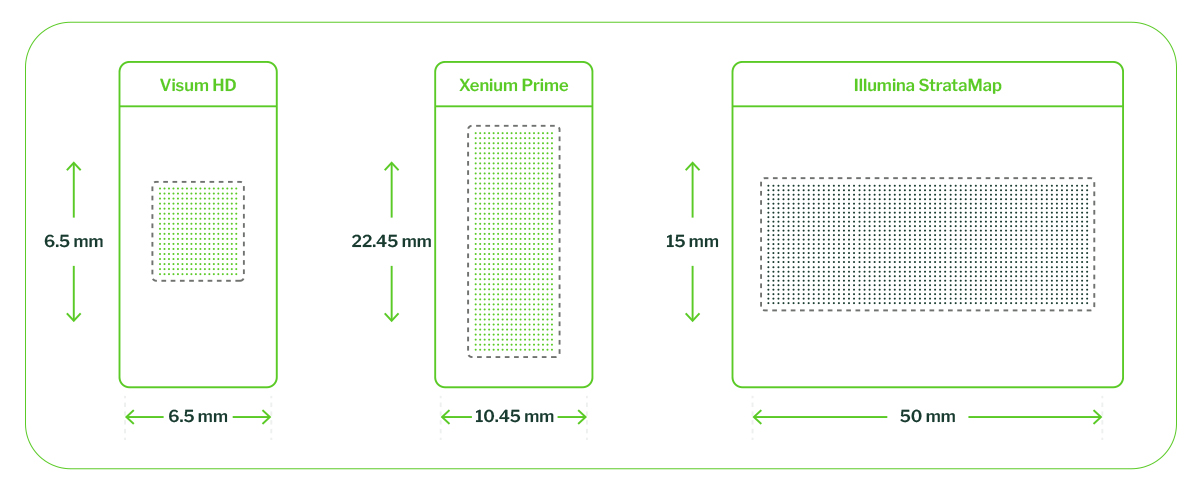
If you are working with large surgical resections, expansive tumor microenvironments, or whole-organ structures (like a cross-section of a mouse embryo or a whole brain), trying to shave them down to fit into a smaller square window forces you to lose valuable morphological context.
StrataMap’s massive 15 mm x 50 mm canvas provides a 7.5 cm2 capture area. This footprint lets you map large tissues intact, or drastically lower technical batch variation by arraying a multi-sample cohort or serial section layout side-by-side across a single continuous slide surface.
3. Do you need true subcellular imaging or high-throughput sequencing metrics?
If your primary biological question hinges on intracellular spatial dynamics—such as seeing exactly where transcripts localize relative to the cell membrane or mapping the structural microenvironment inside a single dense immune niche—Xenium Prime is the gold standard. Because it images transcripts directly inside the cell without a physical transfer step, its cell segmentation and localized resolution are visually seamless.
However, if you are looking to easily integrate your spatial transcriptomic footprints with downstream genomic, epigenetic, or deep sequencing pipelines, StrataMap and Visium HD pipe data straight through standard Illumina sequencing flow cells. They generate standard FASTQ readouts that process rapidly via automated DRAGEN or Space Ranger pipelines.
Quick Decision Rule
- Choose StrataMap if you have large tissues, want to multiplex multiple samples on one slide to save cost, are studying non-standard species, or need unbiased whole-transcriptome discovery at a 1µm feature resolution.
- Choose Visium HD if you have archived human/mouse blocks and need gapless, whole-transcriptome depth at a native 2mm single-cell scale grid.
- Choose Xenium Prime if you require absolute subcellular imaging precision, deep transcript sensitivity for low-abundance targets, and your questions fit within a highly targeted gene panel.
Let’s Design Your Run
Every tissue block comes with unique quirks—from autofluorescence challenges to strict RNA integrity variations. Our team handles the entire technical lifecycle in-house, from precision cryosectioning and instrument runtime through final interactive cloud visualization.
Which spatial framework matches your upcoming project goals? Let us know if you’d like to schedule a feasibility review for your specific sample cohort!